Showing posts with label Art. Show all posts

Monday, January 13, 2020

Boundaries

Art connects itself, at least it does for me. That’s why I have problems with many modern novels and films. I gravitate toward the old. Take photography and literature, for example.

Ansel Adams is widely considered one of the finest photographers ever, along with Dorothea Lange, Carol Highsmith and others. Let’s take Adams. One of the striking things about his work, as he processed it, was the gradation of tones from solid black to pure white. They set the perimeter for the multitude of shades between. Then he dazzled us with the glorious interplay of those tones.

It provides one a footing from which to enjoy the totality of his art, at least it does for me.

Now take Charles Dickens, one of my favorites since a seventh-grade teacher, Mildred Truelock, suggested that, at age 12, Jimmie give Mr. Dickens a dry. It’s been a life-long adventure, though I think perhaps I should have put A Tale of Two Cities off a few years.

What did Dickens do that makes me think of Ansel Adams? His characters matched the tones in Adams photography. Consider David Copperfield. Our protagonist therein faces life framed between the purely good figure of Peggotty and the abysmally bad Uriah Heep. There young David roams with some good but prone-to-backslide characters such as Steerforth and Mr. Micawber. Then there’s the flawed perfection of Mr. Dick, Aunt Bessie, and Dora, their near-goodness shining alongside the ideals. His characters cavort freely between the moral perimeters of good and bad.

Compare that with a popular movie, one that I’d rather spend a week in Branson Missouri than have to watch again. That would be No Country For Old Men. Try as hard as I might, I see no shred of purely good in any character. The same holds true for so many novels. I invariably turn back to my old pal.

We need boundaries for our scales in our life, black and white so to speak, whether we’re taking photos, telling stories, or playing the piano. True artists can make beautiful music between the extremes.

Yes, I know there are exceptions. You can search a Philip Roth novel with a magnifying glass and not find a consistent set of redeeming qualities.

But unless you are Philip Roth, why not stick to classics?
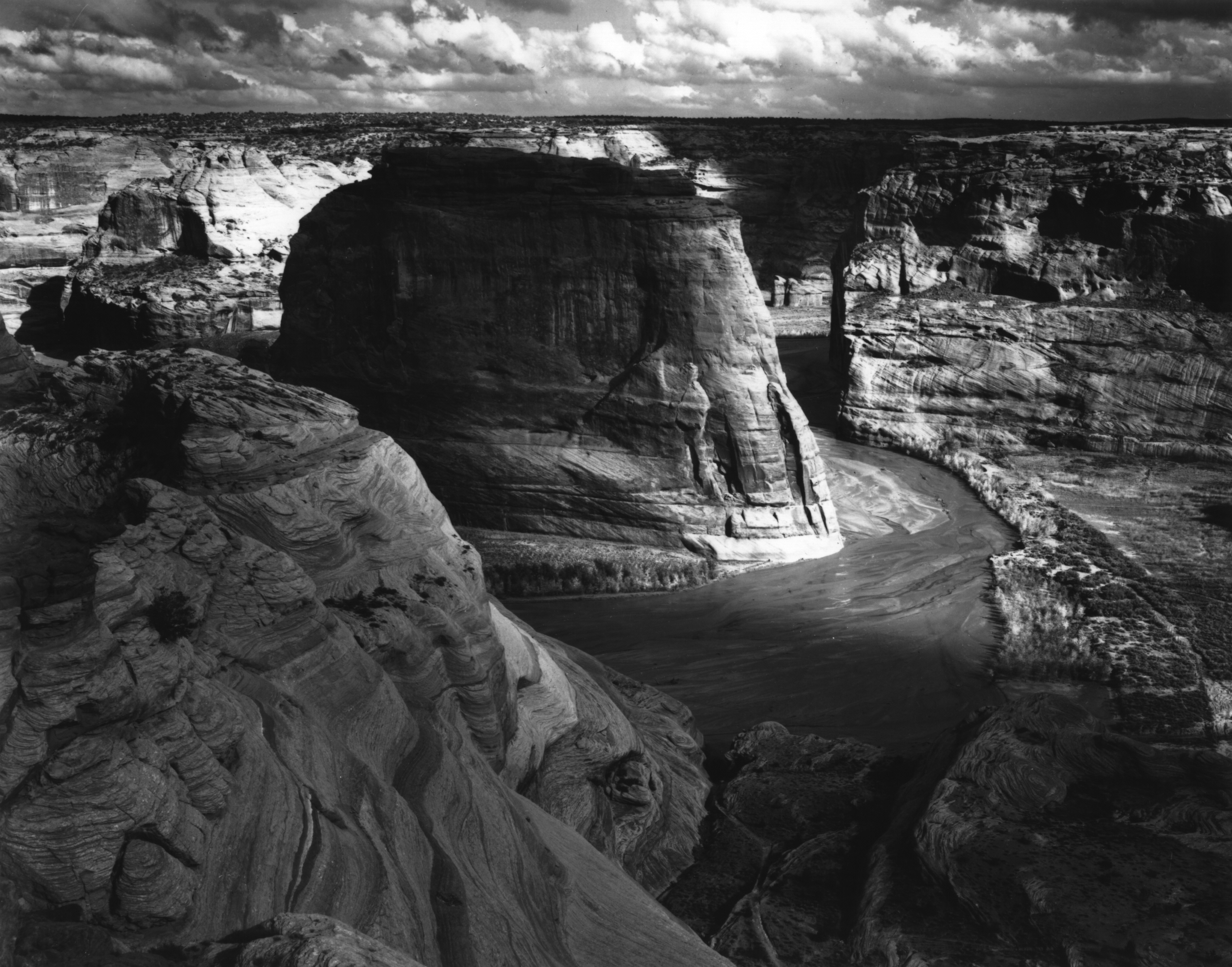
See? No muddy imagery here.


Saturday, November 9, 2019

Confession

May I make a confession? Danke. This has troubled me for years. You see, I traveled up to Eureka Springs via the sensible way this past week. That’s of course through Conway, Clinton, Damascus, (sorry the famous “waving lady” passed away some years ago) Marshall, Harrison, etc. I think GPS systems take you through Oklahoma City from Little Rock. You’ll appreciate my map reading skills when the floods come and the power goes off.

Back to the trip: of course I crossed one of Arkansas’s true treasures, the Buffalo River.

That made me think about way back in history when the Corps of Engineers became offended that there was a free-flowing stream in America and they took out after the Buffalo River, survey-transits a’blazing.

A wonderful cartoonist for a wonderful newspaper, George Fisher (8 April 1923 – 15 December 2003) of the Arkansas Gazette and a group of dedicated environmentalists thwarted those plans. The group called itself, if memory serves, the “Save the Buffalo River Society.”

The time was mid-sixties or so and I was a draft-evader at the University of Arkansas. I joined the Save the Buffalo Society shortly after they formed it. I’ve bragged about that to everyone who would listen. I even bragged about it to those I dated, English Majors mostly. Mister environmentally sensitive: that’s what you could call me.

This self-aggrandizing claim served me well for over 50 years.

Now, after seeing the beauty of that river again, I feel compelled to make a confession, clear my conscience, cleanse my soul, and seek righteousness.

It’s like this. I joined the Save the Buffalo Society because of a girl. She was an art major and a year older than I. Yes, I should have known better than to shift majors. Oh, I wasn’t an English major. I simply dated them. English majors are good folks who know the dangers of a dangling participle. Even B Cole was teaching Language when I met her, and I figured that was close enough.

But an Art major? What was I thinking? Well it wasn’t a case of moral clarity or love of unfettered nature, unfettered things maybe, but nature, no. Anyway, she wanted to save the river from becoming a lake, and I wanted to save her from becoming a lonely Art major. Being the adaptive sort, I signed on to saving the great outdoors. As you might have guessed, such subterfuge didn’t work.

Not only did I fail to impress her, (a pattern that was to exist for years until a superior type of woman picked me out on a parking lot) it got worse. Imagine my shock when I discovered my true value to her. She was using me as a shield to cover up an affair with a married Art professor. Does humiliation never cease? The horror! The horror!

Oh, I did receive one blessing, an “A” in Intro To the Arts. As Swinburn said, “Even the weariest river, winds somewhere safe to sea.”

And I did learn a valuable lesson: English Lit. That’s where the action is.


Friday, February 9, 2018

Morning Thoughts: February 9, 2018

We encountered an invitation yesterday to a feast of cognitive dissonance that would take the cake, so to speak. It produced such a boggling that the mind strained to get over it.

First, as we all know, or should, cognitive dissonance bespeaks the state, prevalent in homo sapiens, of having inconsistent thoughts, beliefs, or attitudes, especially as relating to behavioral decisions and attitude change.

In other words, we have perfected the ability not only to believe, but also to act upon, thoughts that are in exact opposition to one another. To wit:

- Reducing the main source of input into the budgetary process will result in an increase in revenue into that same process.

- A man who mocks those carrying a physical shortcoming through life, who demeans women, violates his marriage vows, and lies without regard for societal damage is a “good Christian man” who was sent by a benevolent deity to rescue America from the “original sin” of universal health care.

- That it is okay to pay some man $4 Million dollars a year to teach temporary college students to play a sandlot game, but it is not okay to teach the wondrous beauty of  expressive dance in our state-supported universities.

That’s the one I’m talking about.

Not teach dance? What a cold and sterile world we would face without dance and the other arts. Why, we might as well not teach a youth, who might be the next Dylan Thomas, Ralph Ellison, Cao Xueqin, Walt Whitman, Alice Walker, or Dante Alighieri, to make whole words out of mysterious symbols. We might as well discourage the girl or boy who might observe a starry sky and, with their gifted hands, produce a masterpiece that would inspire generations for centuries to come.

We should, by this standard, not recognize that the agonies of losing a loved one might be soothed by Bach’s Mass in B Minor.

We could go on forever. Let’s just say that we take a youth and teach that youth nothing but the harsh, cruel, image of a would not ennobled by the beauty of a sunset and only guided, mentally, by the avenues of the mind that lead to greed and personal power. What would we have as a reward for funding such education? If not a Vincent van Gogh, then what?

I don’t know. Maybe a conservative politician?

None of the arts. Just cipherin' for us.

Friday, February 2, 2018

Morning Thoughts: February 2, 2018

 There is such beauty in works of art, one wonders why we concentrate so devotedly upon the mundane. I do it. We all do. Sometimes I leave the village, though, and it is a grand experience.

Consider the adagio movement to Mozart’s Serenade for 13 Winds. That’s the one the Salieri character in Amadeus describes as sounding like a “rusty squeeze box” at first, until the oboe and clarinet pierce the dimness. You won’t see a political candidate producing anything so ephemeral unless Abe Lincoln rises from the dead.

I’ve failed at the arts like I’ve failed at so many things, but I keep trying because the effort makes me smile and keeps me happy. I’m headed out this morning to see a dear friend name Mike Benetz to resume guitar lessons after a holiday break. I’m afraid I’m headed for rough seas.

My fingertips have lost their callouses from lack of practice.

My favorite guitar has the equivalent of a flat tire, i.e. a tuning peg gave up the ghost weeks ago.

I have the rhythmic capability of aging banker at Jimmy Buffett concert.

I haven’t practiced “Mike’s Misery” nearly to the extent that would allow advancement to a half-step closer to just below average.

What is Mike’s Misery, you might ask?
 
Notice: the bottom string is open and must
strike clear. Impossible? Quite.
It is a bar chord form, commonly called an A-shape. You don’t hear much about it because by the time beginners are ready for it, 90 percent of them have given up art and gone back their cell phones for joy and solace. It is, however, one of the basic building blocks of the guitar. During a PBS special this week, I noticed that Eric Clapton dotes on it.

In other words, you can’t live without it.

As you can see from the photograph, it requires a hand position that is literally impossible to make. The price for accomplishing it is ten years constant effort or the price of one’s soul. Take your pick.

I chose practice, for after a quick trip to the crossroad at Clarksdale, Mississippi, I found that my soul had not been rehabbed to the point of being valuable enough yet for the “A-shape.” I was offered a single-note version of Twinkle Twinkle Little Star, and further negotiations proved fruitless.

My problem is that my dear friend Mike thinks that Mike’s Misery is the best thing that has happened to the guitar since The Wildwood Flower first aired. (He has even developed a version of that ditty that requires … you guessed it). Most of the time, nearly all the time, he is one of the kindest, gentlest, most sympathetic, and most wonderful people you could ever meet. But, the insertion of the A-shape into a tune still brings a Paganini-like gleam of devilment into his eyes.

That’s enough. Think I’ll go practice. I don’t want to experience that gleam today. There are things in life worth great effort, after all. Ask Mozart.

Seems easy to me. Ask Clapton.

Monday, December 1, 2014

Talent


Early in the morning thoughts with Franz Schubert Symphony No. 2 in B flat major:

“His talent was as natural as the pattern that was made by the dust on a butterfly’s wings.  At one time he understood it no more than the butterfly did and he did not know when it was brushed or marred.  Later he became conscious of his damaged wings and of their construction and he learned to think and could not fly any more because the love of flight was gone and he could only remember when it had been effortless.” - Ernest Hemingway on F. Scott Fitzgerald from “A Movable Feast,” always one of my favorite passages from the book. (I once asked a young book store clerk if the store had it and she directed me to the cook book section).

The quote has been described as cruelly critical. I see it as praising with faint damnation.
F. Scott and Zelda - a troubled marriage